
Run a seed-list placement test.
Understand your email’s spam risk.
This is an email placement-risk score—not a website backlink or SEO-domain spam score. It summarizes real seed placement and the evidence behind the result.
Live: scoring, prioritized fixes, provider breakdowns, and segment breakdowns are available.
Last reviewed 2026-08-20
Test before every send.
Compare inbox, spam, and missing results.
Use the score and fixes to decide what to change.
Fix with evidence.
See the provider outcome, make one defensible change, and retest the same sending path.
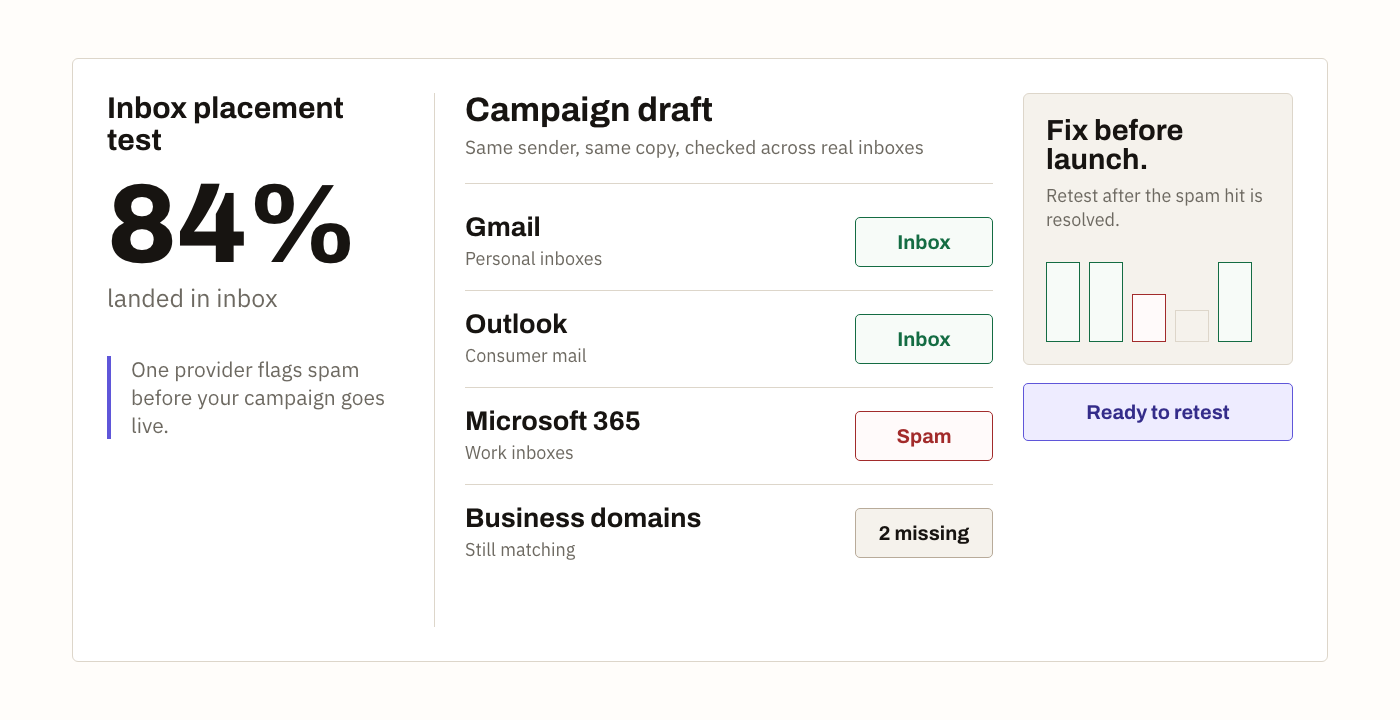
Two products share the phrase spam score
SEO tools sometimes use spam score for a website or backlink profile. Sendlander does not evaluate that. Its score concerns one email test: how controlled inboxes placed the message and which sender, authentication, provider, content, or link evidence needs attention.
That distinction belongs in the first answer because a person checking a website domain should use a different product. Sendlander is for teams deciding whether an email is ready to send.
The score is a summary, not the report
A 0–10 score is useful for orientation and trends, but the provider rows, matched-seed count, Inbox, Promotions, Spam, and Waiting outcomes explain it. The report uses a segmented range instead of a decorative dial and keeps the exact score visible.
Do not optimize the number while ignoring a provider that matters to the audience. A good aggregate can coexist with a serious Outlook or business-inbox problem.
Read the score bands as a triage tool
The segmented score band groups the result into needs-work, mixed, and healthy ranges while keeping the exact value visible. The band is not a scientific probability that a recipient will see the message. It is a compact way to decide whether the next screen should be a launch decision or a repair list.
Always read the matched count beside the score. Four matched seeds and four waiting seeds do not carry the same confidence as eight completed observations. A partial score can still expose a serious spam cluster, but it should stay visibly partial until enough evidence arrives.
An example: the same number, two different repairs
Imagine two reports both score 5/10. In the first, Gmail and Outlook place the message in Spam and DKIM fails on the production route. In the second, completed seeds reach Inbox, but half the test is still waiting. The first calls for an authentication repair before launch. The second calls for patience and delivery evidence, not a rewrite.
This is why Sendlander keeps provider rows, placement counts, and score drivers open around the number. The score helps a busy team notice risk; the evidence tells the owner what to do.
Why the score cannot guarantee placement
Seed inboxes are controlled observations. Real recipients have personal engagement histories, contacts, rules, and organization gateways. Provider filtering also changes. The score can identify risk and support a before-and-after comparison; it cannot promise the folder for every address.
Confidence also depends on matched seeds. An early partial result should stay Pending rather than pretending one observed inbox represents the whole test.
Use severity to choose the repair
Fix a failed production authentication path, compromise, high-risk audience source, or relevant blocklist before fine-tuning copy. Then investigate provider-specific reputation, links, message structure, and lower-severity quality warnings.
Rerun the same kind of test after the repair. The useful outcome is not a perfect number; it is more matched mail in the intended inbox and a cause the team can explain.
Quick answers.
Need API access? Try our partner service MailSlurp.
Related guides:
What an email spam score means, Run an inbox placement test, Prioritize report fixes.
Is a spam score a guarantee?
No. It is a diagnostic summary. Mailbox providers can change placement behavior at any time.
What score will Sendlander use?
The current model is a 0 to 10 score derived from placement, authentication, domain health, content, link, provider, and segment evidence.