
Add a sending domain.
Know when deliverability starts to slip.
Schedule comparable sender checks, keep placement history, and receive alerts when a meaningful score or domain-health signal moves.
Live: monitor schedules create seed-list instructions and alerts. Automated send-as is not included yet.
Last reviewed 2026-08-20
Test before every send.
Send each scheduled test from the same sending platform.
Track health and placement changes together.
Fix with evidence.
See the provider outcome, make one defensible change, and retest the same sending path.
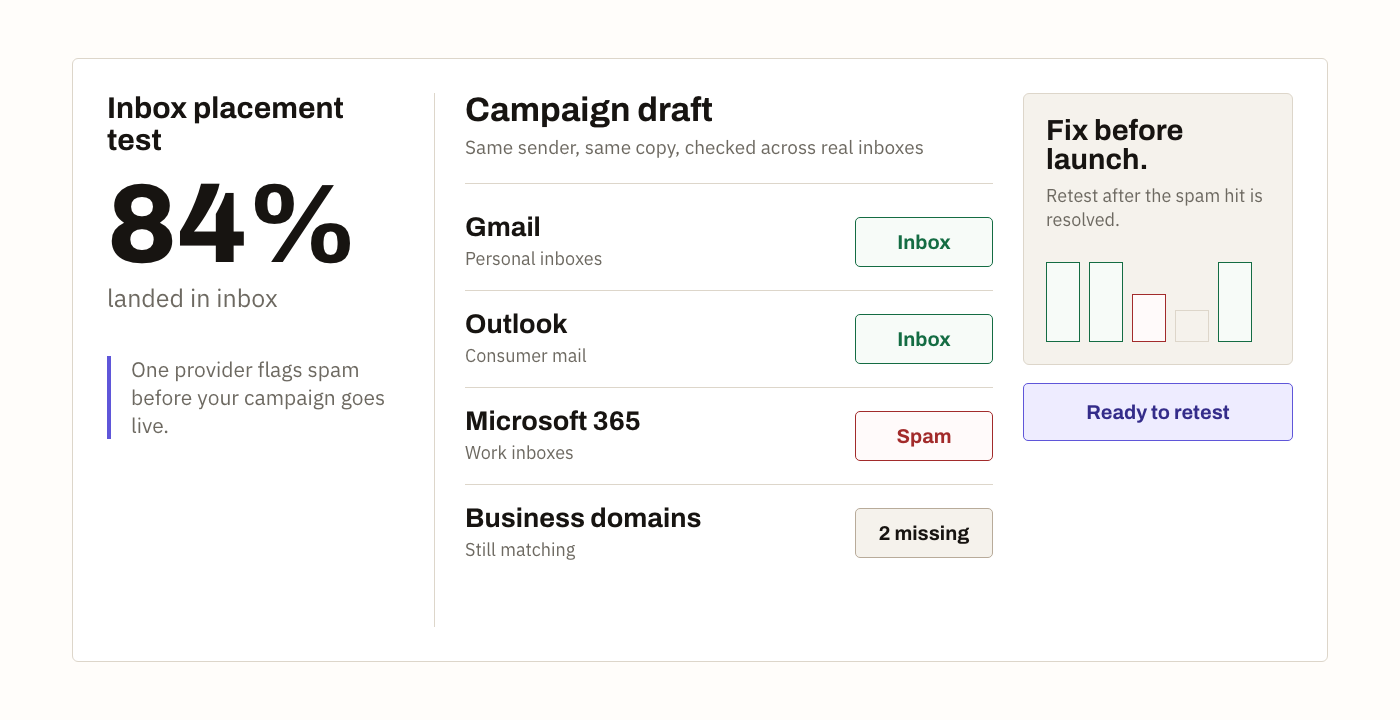
One test is a snapshot
Authentication records drift, platforms change return paths, tracking domains move, lists age, and mailbox providers update their models. Monitoring asks whether a comparable sender and message stream is moving away from its own baseline.
The useful signal is not a universal score on one day. It is a provider, segment, or domain-health change the team can trace to a time and sending configuration.
What the current monitor does
Sendlander monitor schedules create recurring test instructions, preserve report history, and can alert on important changes. The current workflow still requires the customer to send the test email through the normal platform; Sendlander does not impersonate the sender or automate send-as.
That manual step preserves the production path. It also means the schedule needs an owner who will send the comparable message and act on the alert.
Choose a stable baseline
Monitor a named sender and stream with a consistent provider profile. Record authentication, sending platform, From domain, tracking behavior, and representative message type. A trend built from unrelated senders and templates is difficult to interpret.
Set thresholds around meaningful movement and confidence. One late seed should not create an incident, while a repeated provider spam cluster or authentication failure should.
Monitor placement and configuration together
SPF, DKIM, and DMARC can drift when a platform, subdomain, selector, or return path changes. Provider placement can move while those records remain valid because audience response, volume, complaints, links, and provider reputation also move. Keep both kinds of evidence on the same timeline without pretending one causes the other automatically.
Google Postmaster Tools and Microsoft SNDS remain useful provider-owned sources when your volume and infrastructure qualify. Sendlander adds a controlled message-level sample. An alert becomes stronger when a placement decline, provider dashboard change, and production event point in the same direction.
Choose a cadence people can sustain
A weekly or pre-campaign check is often more useful than a noisy daily routine that nobody completes. Test after an ESP migration, sender-domain change, tracking-domain change, authentication edit, unusual complaint event, or material volume increase. Use the same named stream and provider profile whenever comparison matters.
Assign the monitor to one owner. The current workflow prepares the recurring test and alerts the team, but a person still sends through the normal production route. A schedule without an owner creates an impressive calendar and no evidence.
Respond to an alert
Open the underlying report, not only the notification. Decide whether the change came from more completed seeds, a broad placement drop, one provider, authentication, a blocklist, or a message and link change.
Contain a security or audience-quality problem first. Then make one repair, rerun the same stream, and keep both reports as the incident record.
Quick answers.
Does Sendlander send the scheduled monitor emails for me?
Not yet. Sendlander creates scheduled seed-list instructions and alerts; you still send the test email from your normal platform.
Will this replace a DMARC platform?
No. Sendlander will focus on deliverability diagnostics, not full DMARC operations.